
Your Stripe, your payouts
Connect your own Stripe account in a few clicks — no API keys to handle. Customer payments settle directly to your bank; we take 0% of them.
Take the card, hold the deposit, refund it, and bill what's owed after the return — all from the booking itself. Payments run through your own Stripe account at 0% commission, so every rental settles directly to your bank.
No credit card required · Live the same day
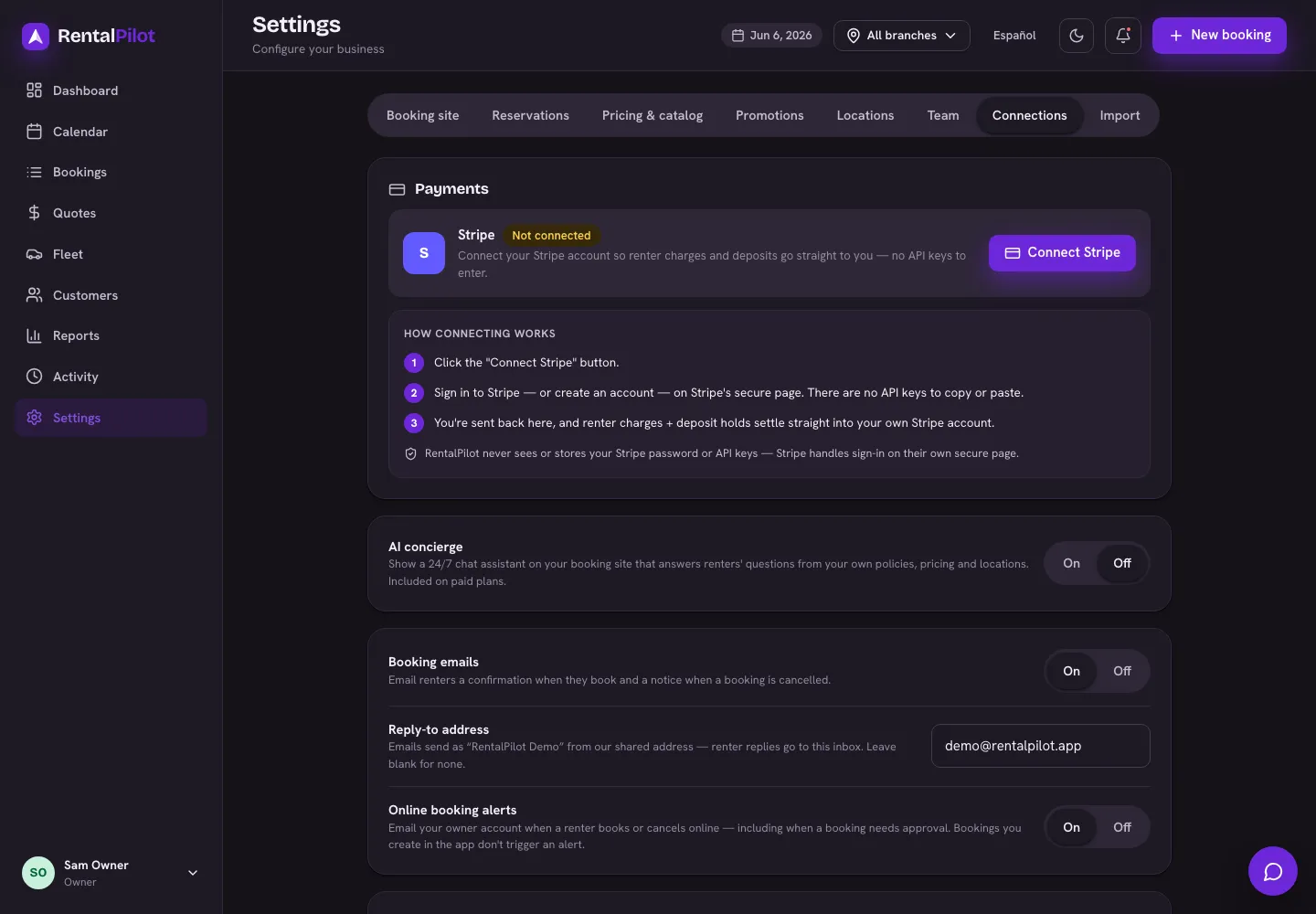
Connect your own Stripe account in a few clicks — no API keys to handle. Customer payments settle directly to your bank; we take 0% of them.
Place a security-deposit hold on the renter's saved card, then release it or capture part of it at check-in if there's damage.
Choose when renters pay — in full online, a deposit with the balance at pickup, or send a single-use payment link for an unpaid booking.
Bill tolls, fines, mileage overage or damage to the card on file once the rental has ended, with each charge itemised on the booking and carried into your reports.
RentalPilot doesn't sit between you and your customers' money. You connect your own Stripe account through Stripe's hosted onboarding — you never enter API keys anywhere — and from then on charges are made on your account. Payouts land in your bank on your Stripe schedule, and RentalPilot takes 0% of them.
That's a structural difference from marketplaces and aggregators, where 10–25% of every booking goes to the platform, and from rental systems that bill per reservation. Here the software costs a flat monthly subscription and the rental revenue is entirely yours. It also means your customers' card data is handled by Stripe, not by us — the card is tokenised in the browser and we only ever store the reference.
The security deposit is the part of a rental most likely to cause friction, and the part most often handled with cash or a scribbled card number. RentalPilot places a proper refundable hold on the renter's card: authorised at pickup, released when the car comes back clean.
Because the card is saved securely at booking, the hold can be placed later without the customer present. If there is damage, you capture part of the hold rather than chasing an invoice, and the amount captured appears on the rental's invoice and in your reports. Protection plans work alongside it — a renter who buys your premium cover can have their deposit reduced or waived automatically, which is the whole reason they buy it.
Not every rental is paid in full up front, so payment timing is yours to set: charge the full amount online at booking, take a deposit now with the balance due at pickup, or collect nothing online and settle at the counter. Long-term monthly rentals can run on instalments instead of one lump sum.
For anything left unpaid, you can generate a single-use payment link from the booking and send it to the customer — they pay on a branded page without needing an account, and the booking updates itself when the payment clears. Promo codes, protection plans, delivery fees, one-way fees and young-driver fees are all priced into the total automatically, and tax is applied at the rate for the pick-up branch rather than a single global rate.
Plenty of rental revenue arrives after the rental ends: a toll, a parking fine forwarded weeks later, mileage over the included allowance, or damage found at check-in. Handled manually, most of it is quietly written off because chasing it costs more than it's worth.
RentalPilot bills those to the card already on file, itemised on the booking so the customer can see exactly what they're paying for, and carried into your cash-flow and receivables reports. Refunds run through the same records: when a renter cancels online inside your free-cancellation window the refund is issued automatically and recorded on the rental's timeline, so the money movement is logged rather than reconstructed later from your card statement.
Stripe, on your own connected account. You authorise the connection through Stripe's hosted onboarding — you never type API keys into RentalPilot — and payouts go from Stripe directly to your bank.
No. We charge a flat monthly subscription based on fleet size and take 0% commission on your bookings. You still pay Stripe's standard card processing fees, exactly as you would with any other provider.
The renter's card is saved securely at booking, and you place a refundable authorisation hold for your deposit amount. Release it at check-in, or capture part of it if there's damage — the captured amount is itemised on the invoice.
Yes. Damage found at check-in can be captured from the deposit hold, and post-rental charges such as tolls, fines and mileage overage can be billed to the card on file, each itemised on the booking.
Generate a single-use payment link from the booking and send it to them. They pay on a branded page with no account needed, and the booking marks itself paid when it clears.
Yes. Your display and charge currency are an operator-level setting, so you can price and take payment in the currency your customers actually use.
Bookings, fleet, payments, customers and reports — all in one place, from $29/mo with no commission.